Using AI to overcome the "linear" limitation of podcasts
Podcasts are an important source of information
There is an increasing number of professionals using podcasts to
share their insights and knowledge in their respective fields,
making podcasts a highly valuable source of information. For
example, the renowned
Lex Fridman Podcast
features Lex Fridman, a computer scientist and researcher,
interviewing guests who are predominantly researchers in the
fields of science and technology. As a result, the podcast content
is often highly specialized and advanced, requiring a strong
comprehension ability to fully grasp. Additionally, podcasts have
a high frequency of updates, making it challenging for listeners
to keep up with and digest all the content.
The challenges of podcasts as an information source
One of the challenges of using podcasts as an information source is their linear nature. When listening to a one-hour podcast, you need to invest one full hour of your time. Even if you listen at 1.5x speed, you still need to dedicate linear time to listen to the entire podcast from start to finish. The term "linear" also implies that you cannot quickly skim through or jump around the content as you would with reading an article. This limitation significantly affects the convenience of extracting information from podcasts. Perhaps due to this reason, people tend to perceive podcasts more as background noise or companionship rather than a serious information source.
AI can break the "linear" limitation
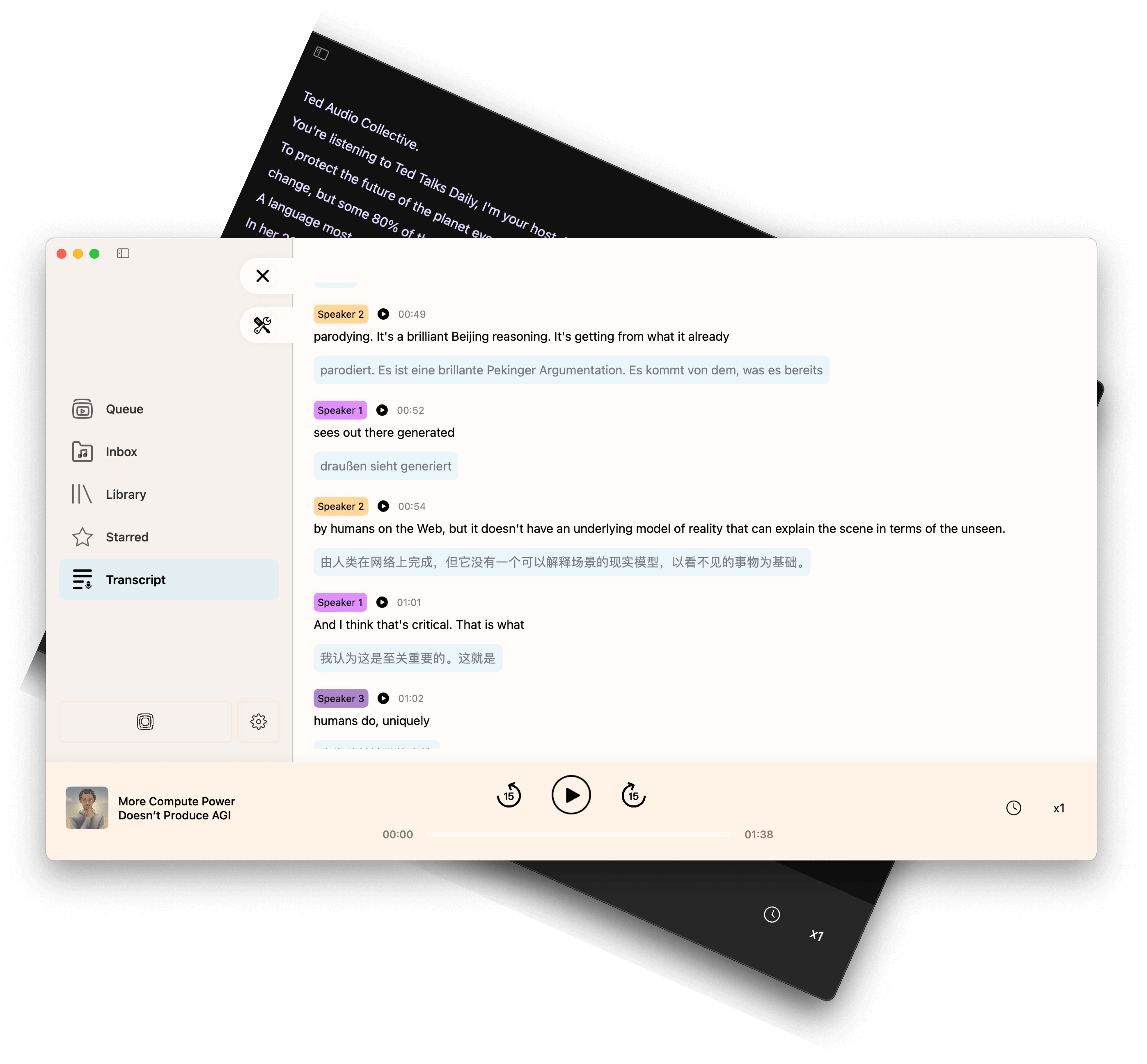
With the advancement of AI, computers, smartphones, and other devices have gained the capability to transcribe audio into text and extract summaries from the text. By leveraging these capabilities, we can convert podcasts into written text, thereby breaking the "linear" limitation of podcasts. For professional podcasts like the Lex Fridman Podcast, once converted into text, it is believed that the difference between it and an interview transcript would be minimal. Once we have the text version of the podcast, we can browse it quickly, similar to reading an article, and even skip forward or backward. Furthermore, we can take notes, perform searches, and treat the podcast as an information source that can be searched and referenced at any time. This transformation allows us to flexibly utilize podcast content and improve the efficiency of information utilization.
「Lightcast↗」,This is a minimalist podcast application that provides AI transcription functionality, allowing English podcasts to be transcribed into text.